People tend to picture the software behind a marketplace as one big machine. Ours is closer to a workshop: a small engineering team, one shared codebase, and a long bench of jobs that sellers mostly never see — until one of them breaks.
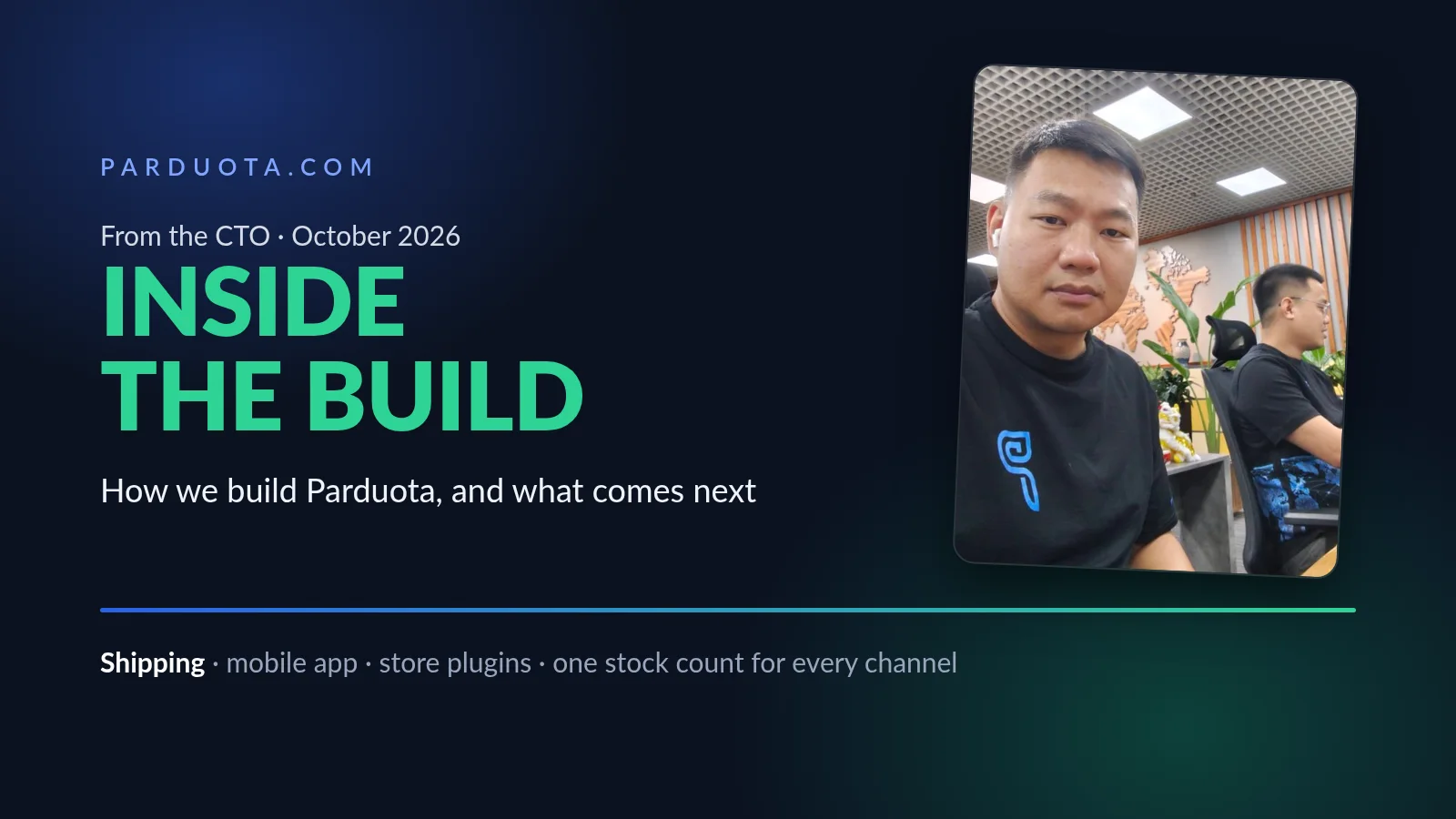
That's us in the photo above, on an ordinary working day, in Parduota T-shirts. I've written before about one feature in depth, what happens when you press AI Smart Listing. This is the wider view: what programming at Parduota actually involves, the rules we hold ourselves to, and what is on the bench right now.
What the code actually does
A seller lists an item once. Behind that one action, the platform has to:
- turn it into a listing eBay accepts — the right category, an English title and a German one for eBay.de, our biggest channel, and photos at the size eBay wants;
- keep the price and quantity in step with what the seller really has;
- bring the order back when it sells, and get the parcel to the buyer;
- handle everything after: buyer messages, returns, refunds, paperwork.
All of it in six languages — English, Lithuanian, Polish, German, Latvian and Estonian — from the website and from a Telegram bot, with a mobile app on the way.
Most of our work is not the screens. It's the plumbing between them and the marketplaces: what happens when eBay's answer is late, or incomplete, or arrives looking like a yes when it means no.
How we work
Smallest version first. Most features start bigger in our heads than they end up in the code. We build the smallest version that solves the real problem, put it in front of sellers, and let their use decide what comes next. A feature that ships in a week and gets used beats a complete design that is still being argued over a month later.
One function, many front doors. The website, the Telegram bot and the app call the same code. When we fix something, it's fixed everywhere at once. When two of them behave differently, that's a bug, not a variant.
Measure, don't assume. Carrier and marketplace documentation is often incomplete and sometimes simply wrong. Before we build on an API, we test what it really does and write the answer down. More than once that has meant discovering that a field documented as one thing means another, or that an error comes back looking exactly like a success.
The seller's listing is the seller's. Automation is there to save a seller's time, never to surprise them. One concrete rule: when an item sells out, we set its eBay quantity to zero instead of ending the listing. The listing keeps its sales history, and comes back the moment stock does.
Security is not a feature. Staff accounts need two-factor sign-in, and the keys to marketplace and carrier accounts are encrypted at rest. Nobody notices this work when it's done right, which is exactly the point.
What we are building now
Shipping that compares, not just ships
Today our parcels go out through ZipAsGo. What we are building is the layer above it: one request, several carriers quoting the same parcel, sorted by a price that means the same thing in every row — VAT included, always. That sounds trivial and isn't. Put one carrier's price without VAT next to another's with VAT, and the wrong option looks cheapest.
A carrier that can't serve a route simply drops out of the comparison instead of breaking it. You can see how it will feel in the Shipping Simulator — its prices are demo figures for now, not live quotes.
We also watch every parcel against the delivery date its carrier promised. When one goes quiet past that date, our team hears about it before the buyer has to ask.
A mobile app for sellers
We are building a native app for sellers, and the daily loop already works in it: managing listings, following a sale through to dispatch, answering offers, searching and filtering your stock. A few things will deliberately stay on the website — buying points and changing plans, for example — so the app shows your balance and links out, instead of growing a second checkout. We'll announce it here when it's ready for everyone.
Plugins for the shop you already have
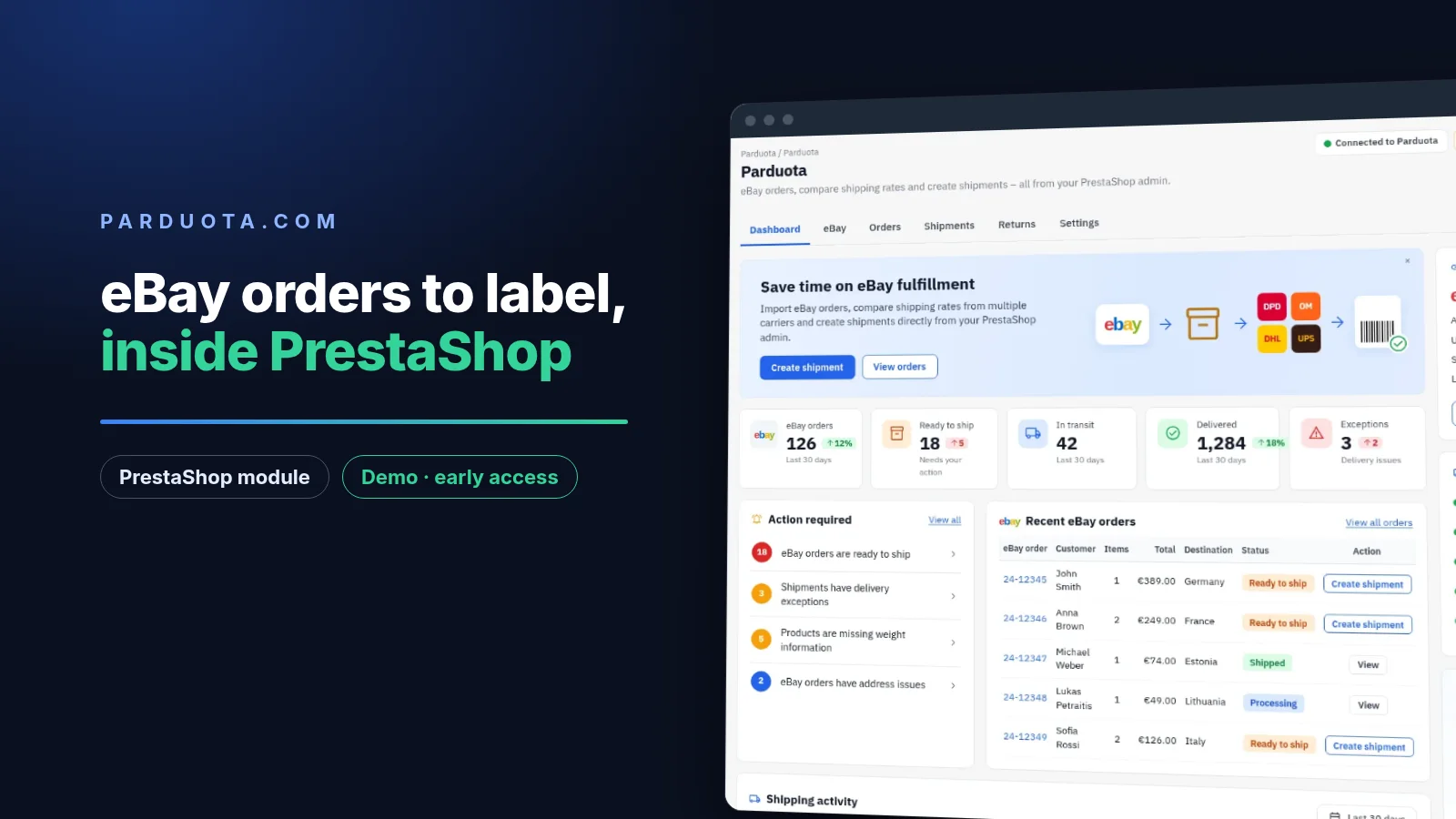
Many sellers already run their own web shop on PrestaShop or WooCommerce. Instead of asking them to move, we are building plugins that bring eBay orders and shipping into the back office they already use. Both exist today as working demos on sample data. I wrote about the PrestaShop module in more detail, and the integrations page is where to ask for early access or tell us which platform you need.
One stock count, every channel
This is the hardest problem on our list, and the most important one. A used car part usually exists exactly once. List it on eBay, on Allegro and in our own store, and the default outcome is that it sells twice.
So we are rebuilding how stock works: one quantity per item as the single source of truth, and every marketplace a mirror of it. A sale anywhere updates everywhere else, with retries when a marketplace doesn't answer the first time. It's being built in stages, so nothing changes under a seller's feet overnight. Connecting the accounts is the easy part. Making sure one part is sold once is the real work.
Catalogue sync for car-part sellers
Many dismantlers already keep their stock in an online catalogue. For them we're building a sync that turns that catalogue into eBay listings — German titles for eBay.de, one listing per part number — and, more importantly, notices when a part is gone at the source and drops its eBay quantity to zero within hours. Every shop's catalogue is a little different, so this one is set up together with the seller rather than switched on with a button.
Smaller things that shipped lately
Not everything is a big project. Some recent ones:
- Quick publish — review a draft and publish it from a side panel on your seller dashboard, without opening the full editor.
- Advanced filters on the seller dashboard, so a large inventory narrows down to the handful of listings that need attention today.
- Allegro import — bring your existing Allegro offers into Parduota as drafts instead of retyping them.
- The Academy — a free five-lesson course on selling on eBay, written for people who have never done it.
- One inbox for our support team — eBay messages, seller tickets and late parcels in a single queue, because how fast your problem gets solved shouldn't depend on which tab someone had open.
Talk to us
The best items on our list started as a seller telling us something was slow, confusing or simply broken. If you hit one of those, tell us — be specific, and a screenshot helps more than you'd think. That is, quite literally, how our to-do list gets written.